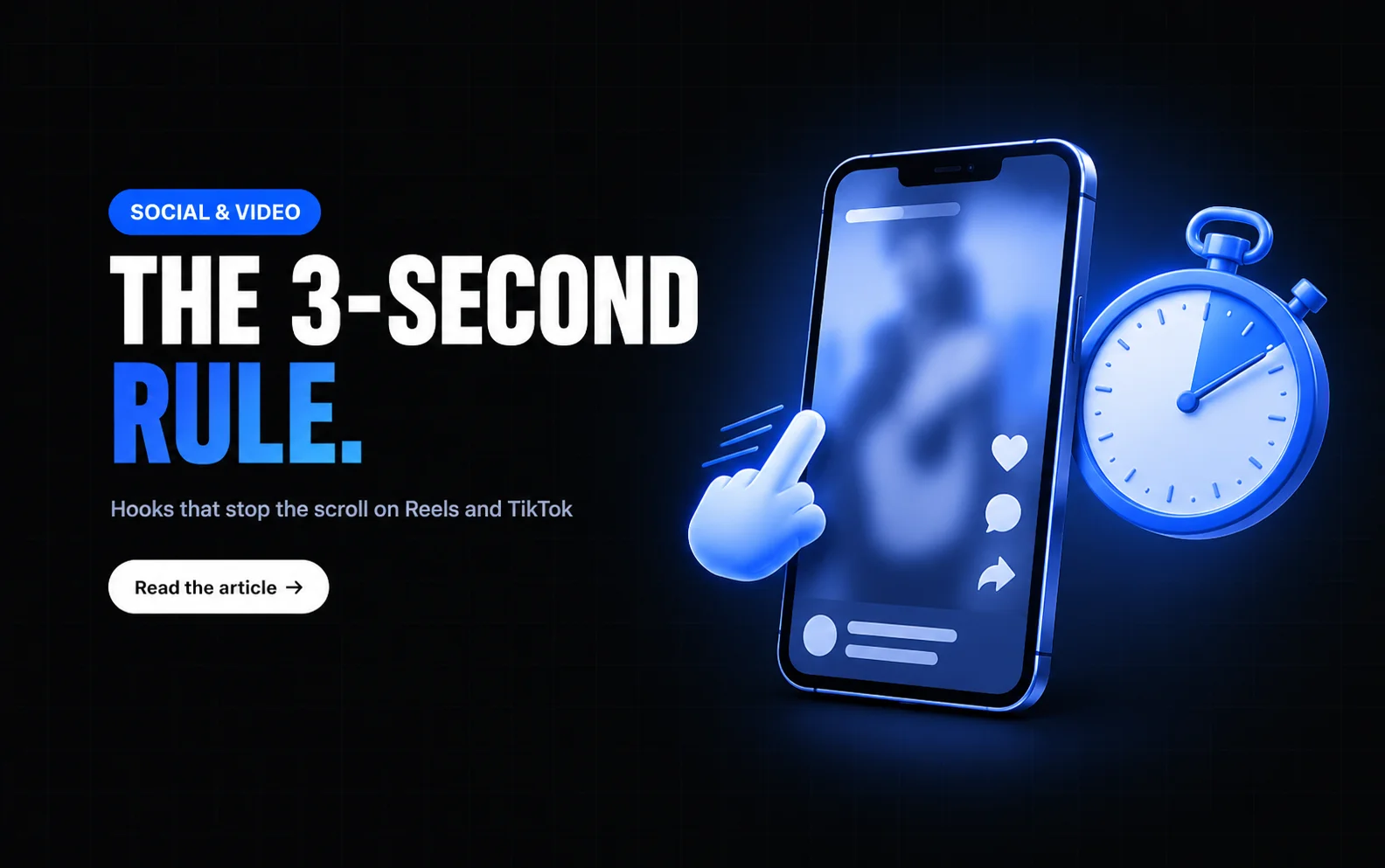
The 3-Second Rule: Scroll-Stopping Hooks for Reels
On Reels and TikTok you get three seconds, not thirty. These are the scroll-stopping hooks we use for brands, with examples, and how to test them.
Every feed is a contest for attention, and the first three seconds decide whether anyone sees the rest of your video. Scroll-stopping hooks are the difference between a Reel that gets 400 views and the same Reel getting 40,000. The footage after the hook can be identical; the opening is what the algorithm tests first. Here is how we write, shoot and test hooks for brands, with examples you can copy today.
Why three seconds
Instagram and TikTok decide how far to push a video based on early signals: did people stop, did they keep watching past the first moments, did they rewatch. A viewer who swipes at second two tells the platform the video is not worth showing to anyone else. That is why a strong hook does more for reach than a bigger budget, a better camera or a longer caption.
Six scroll-stopping hooks that work
- 1The pattern break. Open on motion, an odd angle, a close-up or an unexpected sound. The brain notices change and stops autopiloting.
- 2The bold claim. Say the most surprising true thing first, then prove it. 'This ₹300 fix doubled our client's orders' is a hook; 'Tips to grow your business' is not.
- 3The open loop. Start a thought the viewer needs finished: 'Most Lucknow restaurants post at the wrong time, and here is the right one.'
- 4The mirror. Show the viewer their exact problem in the first frame: a messy storeroom, a slow website, an empty appointment book.
- 5The result first. Show the finished dish, the transformed room or the number on screen before the process.
- 6The direct address. Name the audience in the first line: 'If you run a salon in Lucknow, watch this.' People stop when it is clearly for them.
Make the hook visual, not just verbal
Most people scroll with the sound off, so a spoken hook alone fails. Put the hook on screen as large text in the first frame, cut within the first second, and make sure the first frame is interesting as a still image, because that is what shows while the video loads. Keep faces close to the camera and never open on a logo or a title card; both are swipe signals.
Hooks for different kinds of business
- ✦Restaurants and cafes: the pour, the cheese pull, the first bite. Food moving beats food sitting still.
- ✦Clinics and salons: the before and after, revealed in the first two seconds, with the explanation after.
- ✦Coaching and education: a question from an exam or interview that most people get wrong.
- ✦E-commerce and D2C brands: the product solving the problem, not the product on a white background.
- ✦Services and agencies: a number on screen, then the story behind it.
Test like a scientist
Film three different openings for the same video and let the numbers pick the winner. On a shoot this costs ten extra minutes, and it tells you more than any opinion in the room. Compare the three-second hold rate and the average watch time in Instagram's insights after 48 hours, then use the winning style on the next five videos. Small changes to the first three seconds routinely outperform a full reshoot of everything that follows.
A simple checklist before you post
- ✦Does something move or change in the first second?
- ✦Is the hook readable as on-screen text with the sound off?
- ✦Would the first frame make sense as a thumbnail?
- ✦Does the opening promise something the video actually delivers?
- ✦Have you filmed at least two alternative openings?
Hooks are a skill, and like any skill they improve with reps and measurement. If you would rather hand the whole thing over, scripting, filming and editing is what our video team does every week for brands in Lucknow and across India, and our social team plans what gets posted and when.
Want content people can’t scroll past?
We plan, shoot and edit Reels and brand videos, and grow the accounts they run on.
Before you ask
Questions about this one
The principle does; the timing shifts. Reels and TikTok judge you in about three seconds, YouTube gives you a little longer, and a LinkedIn video is often watched muted with captions. Same hook, different cut.
Then lead with the problem, not the product. A frustrated face, a messy before, a number on screen: the hook is about the viewer's situation, and the product turns up once they are watching.
Three per video is our usual rule: same body, three different openings. It costs almost nothing extra on the shoot and it tells you more than any opinion in the room.
Yes. Scripting, filming and editing are what our Video Production service does, and our social team plans what gets posted and when.
The newsletter
One useful email, now and then
New articles as they land — what’s changing in search and AI answers, and what we’d do about it. No pitching, unsubscribe in one click.