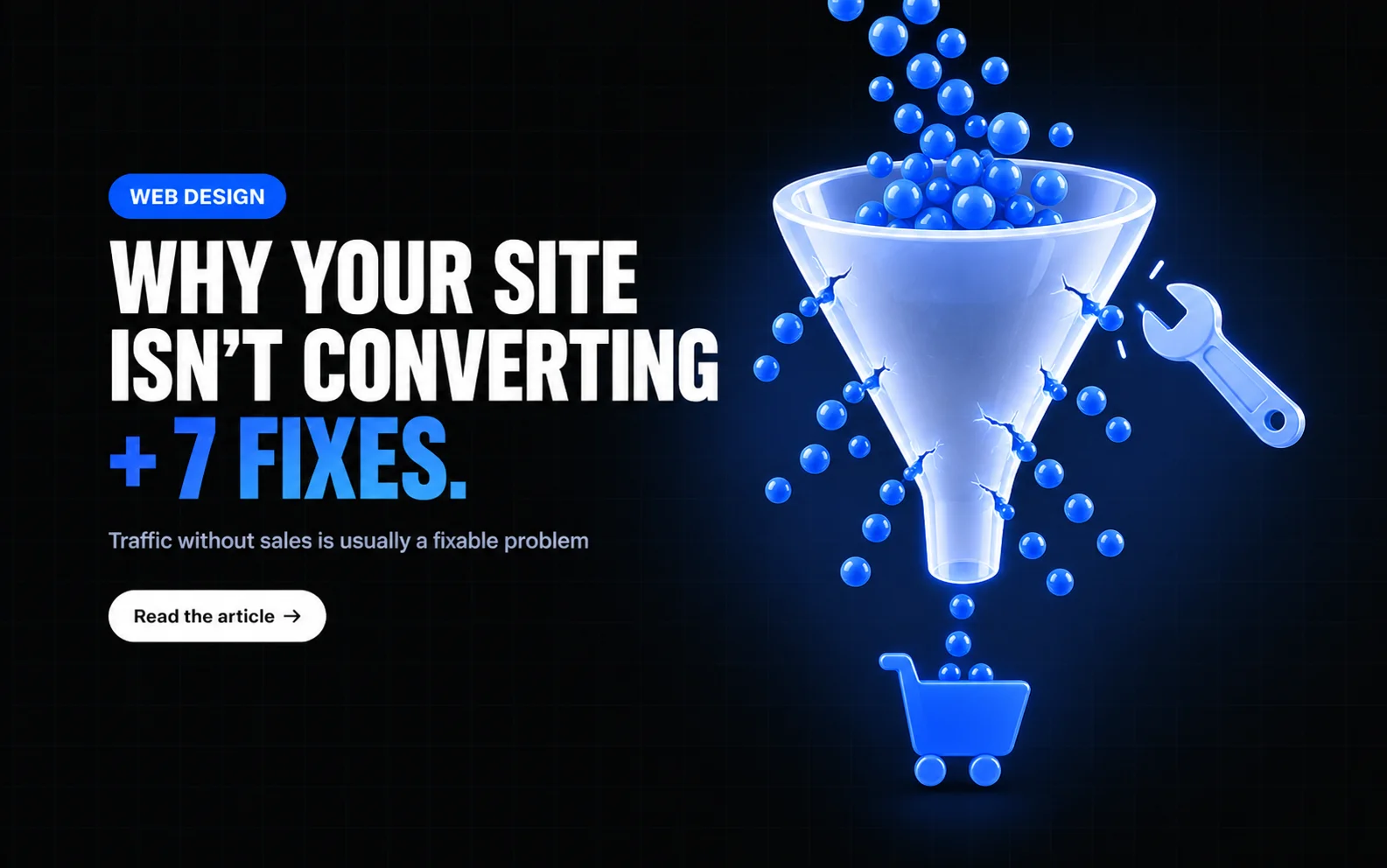
Website Not Converting? 7 Fixes That Work
Traffic without sales is rarely a traffic problem. Website not converting? These are the seven fixes we make first on almost every site we audit.
If people are visiting but not buying, booking or enquiring, your website is leaking. A website not converting is rarely a traffic problem: the visitors are there, and something on the page is sending them away. The good news is that the leaks are almost always in the same seven places, and most of them can be fixed without a redesign. Here is the order we fix them in, and why.
First, find out where people leave
Before changing anything, look at the data. Google Analytics shows which pages people land on and where they exit; a free heatmap tool shows how far they scroll and what they tap. Ten minutes with these two usually points at one or two pages responsible for most of the loss. The usual suspects are the contact form, the pricing page and the checkout. Fix those first, instead of redesigning pages that were already working.
Fix 1: Make it fast
Every extra second of loading costs you visitors, especially on phones over mobile data, which is how most of India browses. Compress and resize images, remove plugins and scripts you do not use, and aim for a page that feels usable within about two seconds. Run your site through Google PageSpeed Insights; if the mobile score is under 70, start here.
Fix 2: Say what you do above the fold
A visitor should understand what you offer, who it is for and why you, within five seconds and without scrolling. Replace vague headlines like 'Welcome to our website' with a plain statement: 'Custom kitchen cabinets in Lucknow, installed in 10 days.' Put the one thing you want them to do right beside it.
Fix 3: One page, one goal
Pages with five buttons convert worse than pages with one. Decide the single action that matters for each page, whether that is a WhatsApp message, a booking or an add to cart, and make that button impossible to miss. Everything else becomes a quiet secondary link.
Fix 4: Show proof early
Reviews, client logos, numbers and photos of real work belong near the top of the page, not in the footer. People decide whether to trust you long before they reach the bottom. Three honest Google reviews above the fold do more than a paragraph about your values.
Fix 5: Design for thumbs
Most visits happen on phones. Test every tap, form, menu and button on a real device, not a shrunken browser window. Buttons need to be large enough for a thumb, text needs to be readable without zooming, and the WhatsApp or call button should be reachable with one hand.
Fix 6: Cut the form
Every extra field loses people. Ask only for what you need to respond, usually a name and a phone number or email, and collect the rest in the conversation. If your form has more than four fields, cut it in half and watch what happens to submissions.
Fix 7: Measure every change
Change one thing at a time and give it two weeks. Keep a simple log: what you changed, when, and what happened to enquiries. Without this you will undo good changes and keep bad ones, and you will never know which fix actually worked.
What to expect
Start with fixes one to three. On most sites we audit, speed, clarity and a single clear action produce a visible difference in enquiries within a few weeks. Then keep going: a website is never really finished, it is a page you keep tuning. If you want a second pair of eyes, we audit sites for free and tell you plainly whether you need fixes or a rebuild.
Want a website that sells?
We design and build fast websites and online stores that rank on Google and turn visitors into customers.
Before you ask
Questions about this one
Usually just fixes. We audit first and tell you honestly: if speed, clarity and the offer can be sorted on the site you have, that is cheaper and faster than starting again.
Aim for the page feeling usable in about two seconds on a normal phone connection. Images and third-party scripts are almost always the culprits when it does not.
What you do, who it is for, and the one action you want, plus a piece of proof. If a stranger cannot say what you sell in five seconds, that section needs rewriting.
Measure before you change anything. Analytics plus a heatmap tells you where people stop, so you can fix the real leak instead of redesigning things that were fine.
The newsletter
One useful email, now and then
New articles as they land — what’s changing in search and AI answers, and what we’d do about it. No pitching, unsubscribe in one click.